From Individual AI Assistants to Shared Engineering Intelligence: Part 1
Why organizations need an internal AI platform that shares engineering knowledge, rules, skills, and ADRs across Claude Code, Cursor, Copilot, and future AI agents.
AI coding assistants have become a normal part of software development. Inside one engineering organization, developers may use Claude Code, GitHub Copilot, Cursor, OpenCode, DeepSeek-based coding agents, or other tools depending on workflow and preference.
That flexibility is a good thing. Developers should use the tools that make them most productive.
A different problem is easy to miss:
The AI tools are shared across the organization, but the engineering knowledge is not.
One developer discovers a better architectural pattern. Another writes useful coding rules. Someone else finds a security practice the whole team should follow. A project carries architecture decisions that are not obvious from the code. Another developer spends hours solving a production issue.
Where does that knowledge go?
Too often it stays inside individual AI conversations, prompts, local configuration, IDE rules, CLAUDE.md files, Cursor rules, Copilot instructions, personal notes, and scattered documentation.
The result is a fragmented knowledge ecosystem. That creates a new challenge for AI-assisted development: every assistant is helpful, but none of them share the same organizational brain.
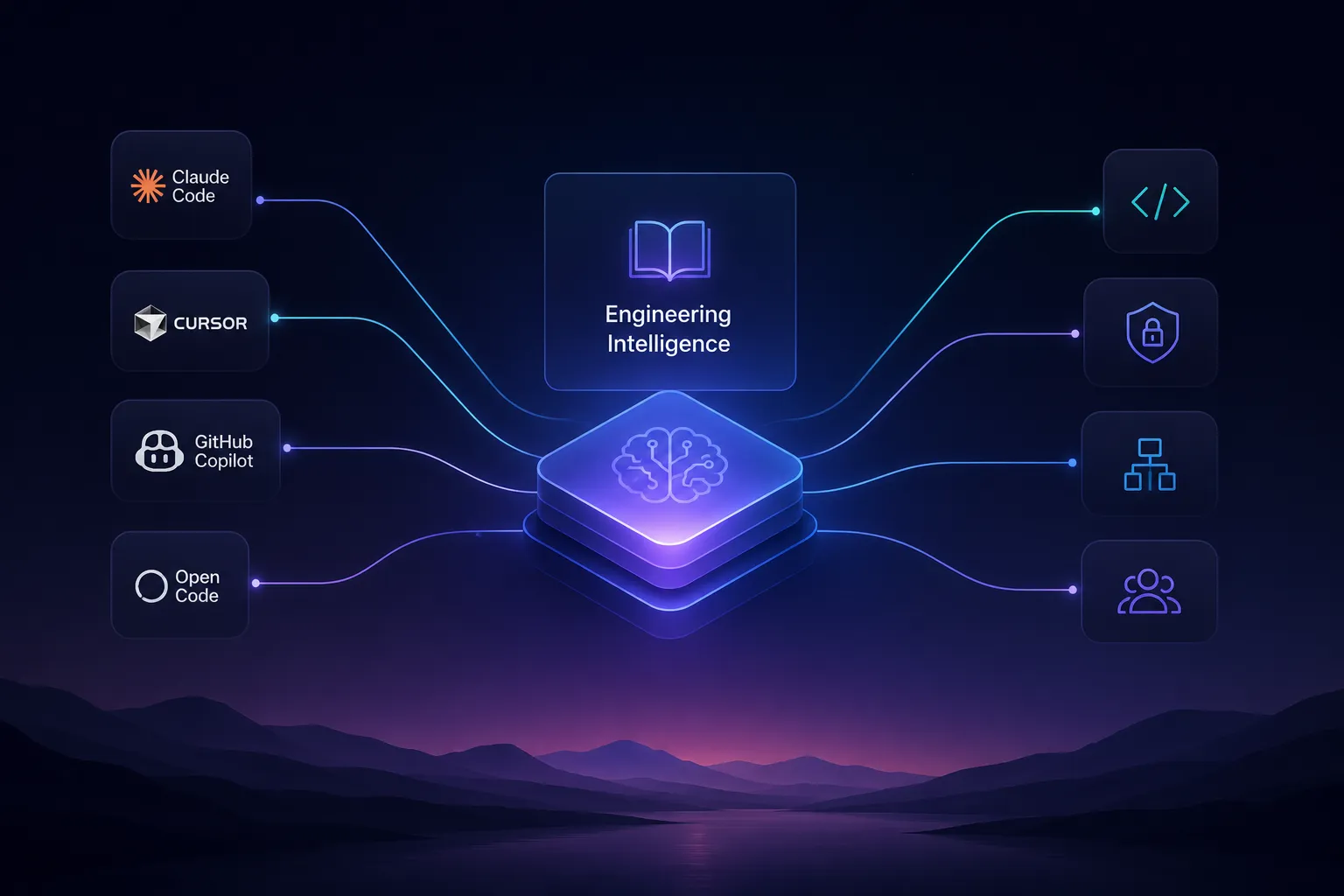
This is context engineering at company scale. The question is not only what one model sees in a single chat. The question is how the whole organization supplies the same project knowledge, standards, and constraints to every AI coding tool.
The Problem With Tool-Specific Knowledge
Imagine four developers working in the same organization.
Developer A
    │
    └── Claude Code
          └── Personal Rules
          └── Personal Skills
          └── Personal Context

Developer B
    │
    └── Cursor
          └── Cursor Rules
          └── Personal Prompts
          └── Personal Context

Developer C
    │
    └── Copilot
          └── Copilot Instructions
          └── Personal Workflow

Developer D
    │
    └── OpenCode
          └── AGENTS.md
          └── Personal Configuration
Everyone is using AI. Everyone may be teaching that AI something slightly different.
That can produce:
- Different coding patterns
- Different architectural approaches
- Different testing strategies
- Different error-handling patterns
- Different security practices
- Repeated problem solving
- Knowledge silos
- Difficult onboarding
- Inconsistent AI-generated code
The problem is not that developers use different AI tools. The problem is that engineering knowledge is not centralized.
Standardizing on a single assistant does not fix this. The next preferred tool will arrive. If knowledge lives inside Cursor rules, Claude project files, or Copilot instructions, the organization has to rebuild its context every time the tooling changes.
What If Engineering Knowledge Had Its Own Platform?
Instead of asking which AI coding tool the team should standardize on, a better question is:
How can we make our organization’s engineering knowledge available to every AI tool?
That question leads to an internal AI platform: a centralized engineering intelligence layer that AI assistants consume, rather than own.
                         INTERNAL AI PLATFORM
                                  │
                   ┌──────────────┴──────────────┐
                   │                             │
            KNOWLEDGE BASE                 ENGINEERING RULES
                   │                             │
        ┌──────────┼──────────┐       ┌─────────┼─────────┐
        │          │          │       │         │         │
     Project      Tech      Company  Coding   Security  Architecture
     Knowledge  Knowledge   Standards Rules     Rules      Rules
        │          │          │       │         │         │
        └──────────┴──────────┴───────┴─────────┴─────────┘
                                  │
                           KNOWLEDGE API
                                  │
                ┌─────────────────┼─────────────────┐
                │                 │                 │
             Cursor          Claude Code        Copilot
                │                 │                 │
             OpenCode         Other Agents      Future AI
The idea is simple:
AI tools become consumers of organizational knowledge instead of becoming the owners of that knowledge.
Cursor, Claude Code, Copilot, and OpenCode still matter. They remain the interface developers already like. The platform sits underneath them as the shared source of engineering context.
What Should an Internal AI Platform Know?
This should not be another prompt library. Prompts are only a small piece of the problem.
The platform should hold several kinds of engineering knowledge, each with a different job.
1. Project Knowledge
Every software project has knowledge that developers need beyond the source code itself.
Project
├── Architecture
├── Domain
├── APIs
├── Database
├── Integrations
├── Deployment
├── Configuration
├── Architecture Decisions
├── Known Issues
└── Lessons Learned
Consider a project where the team has decided:
All order processing must go through an asynchronous workflow.
A new developer, or a new AI agent, might look at the code and ask:
Why don’t we just call the service synchronously?
The answer is not always obvious from the implementation. Project knowledge supplies that context so humans and agents make the same decision the team already made.
2. Technology Knowledge
Some knowledge applies across multiple projects.
.NET
├── Web API
├── EF Core
├── Dependency Injection
├── Authentication
├── Caching
├── Testing
└── Performance

React
├── Components
├── Hooks
├── State Management
└── Testing

Angular
├── Components
├── RxJS
├── State Management
└── Testing

Azure
├── App Service
├── Functions
├── Service Bus
├── Key Vault
└── Monitoring
If the organization already has a preferred way to build .NET APIs, developers and AI tools should not rediscover that approach in every repository. Technology knowledge is the shared playbook for stacks the company repeats.
3. Company Engineering Standards
This is where organizational consistency becomes important.
Examples include:
- Coding standards
- Git workflow
- Pull request standards
- Testing standards
- Logging standards
- Documentation standards
- API standards
- Dependency management
- Observability
- Performance guidelines
For example:
Every API should:

✓ Validate input
✓ Follow standard error handling
✓ Use structured logging
✓ Implement appropriate authorization
✓ Avoid exposing sensitive information
✓ Have appropriate tests
These are not merely AI instructions. They are engineering standards. AI tools are simply another consumer of those standards, the same way a human reviewer is.
4. Engineering Rules
Rules define constraints that AI-assisted development should respect. I would organize them into categories:
Coding Rules
Security Rules
Architecture Rules
Performance Rules
Testing Rules
Documentation Rules
Security rule
Never log:

- Passwords
- Access tokens
- Refresh tokens
- API keys
- Sensitive personal information
Architecture rule
Controllers must not directly access the database.

Controller
    ↓
Application Layer
    ↓
Domain / Business Logic
    ↓
Infrastructure
    ↓
Database
The AI is not simply generating code. It is generating code within organizational constraints.
Rules work best when they are short, enforceable, and easy to retrieve. A giant prompt that mixes security, style, and architecture is harder to review, version, and reuse across tools.
5. Skills
There is an important difference between a rule and a skill.
Rule: What should the AI follow?
Skill: How should the AI perform a particular task?
For example:
skills/

create-api
code-review
create-unit-tests
debug-api
security-review
database-migration
performance-analysis
create-react-component
create-angular-component
A create-api skill might define a standard process:
1. Inspect existing API patterns.
2. Inspect project architecture.
3. Inspect DTO conventions.
4. Inspect validation rules.
5. Inspect authorization requirements.
6. Implement the endpoint.
7. Create tests.
8. Run tests.
9. Check logging.
10. Review against project rules.
That is much more useful than stuffing hundreds of instructions into one giant prompt. Skills turn repeated engineering work into a reusable procedure that any compatible agent can follow.
This is the same idea that makes AI agent frameworks valuable: give the agent a clear workflow, not only a list of wishes.
6. Architecture Decision Records
Another important component is the architecture decision record (ADR).
An ADR captures not just what the architecture is, but why it exists.
ADR-0012

Title:
Use asynchronous messaging for order processing

Status:
Accepted

Context:
Order processing can take several seconds...

Decision:
Use asynchronous messaging.

Consequences:
- Eventual consistency
- Retry handling required
- Idempotency required
- Dead-letter handling required
This becomes valuable context for both developers and AI agents. Without ADRs, an assistant can propose a “simpler” design that quietly undoes a decision the team already paid for.
7. Lessons Learned
This could become one of the most valuable parts of the platform.
Imagine Developer A spends several hours debugging an EF Core performance issue and discovers:
Problem:
An N+1 query pattern caused excessive database calls.

Root Cause:
Related data was being queried repeatedly.

Solution:
Change the query strategy and explicitly load the required data.
Normally, this knowledge stays with that developer. Instead, it can become a proposed organizational lesson:
Technology:
.NET / EF Core

Problem:
N+1 query caused excessive database calls.

Solution:
...

Affected Project:
Project A

Impact:
High
After review:
Developer
    ↓
Proposed Lesson
    ↓
Team Review
    ↓
Approved
    ↓
Knowledge Base
Now another developer, and every connected AI tool, does not have to learn the same lesson the hard way.
The Knowledge Feedback Loop
This is more interesting than a static documentation site. The platform can create a continuous learning loop:
Developer
    ↓
AI Assistant
    ↓
Problem / Discovery
    ↓
Proposed Knowledge
    ↓
Review
    ↓
Approved
    ↓
Shared Knowledge
    ↓
Every Developer + AI Tool
The organization’s engineering knowledge becomes a living system. People still discover things in the flow of work. The difference is that a discovery can be reviewed once and then reused by every assistant, instead of living forever in one chat transcript.
Governance matters here. Not every note should become a company rule. Proposed knowledge needs ownership, review, and a way to retire advice that is no longer true.
The Most Important Architectural Principle
There is one principle I would strongly recommend:
Do not make Claude Code, Cursor, Copilot, or any other AI tool the source of truth.
AI tools will change. Today’s preferred tool might be Cursor. Tomorrow it might be another agent.
The organization should not rebuild its knowledge system every time the AI tooling changes.
                 ORGANIZATIONAL KNOWLEDGE
                           │
                           ▼
                    KNOWLEDGE ENGINE
                           │
              ┌────────────┼────────────┐
              │            │            │
            Claude       Cursor       Copilot
              │            │            │
           OpenCode    Other Tools   Future AI
The tools become consumers. The organization’s knowledge remains independent.
That independence is what makes an internal AI platform durable. Rules, skills, ADRs, and lessons can be versioned, reviewed, and searched like any other engineering asset. Each tool then receives a projection of that knowledge in the format it understands.
Where MCP Fits
This naturally brings us to the Model Context Protocol (MCP).
MCP can become an important interface between AI agents and a centralized knowledge platform. I do not think MCP should be the foundation.
The foundation should be the knowledge engine. MCP should be one of the interfaces through which AI agents access it.
                  KNOWLEDGE ENGINE
                         │
                ┌────────┴────────┐
                │                 │
             REST API            MCP
                │                 │
              CLI              AI Agents
                │                 │
             Portal       Claude / Cursor /
                           Other Agents
REST and a CLI still matter for portals, scripts, and humans. MCP matters because more coding agents can call tools and read resources through a shared protocol. Keeping both as interfaces, not as the system of record, preserves a tool-agnostic architecture.
Retrieval-augmented generation can sit behind the same engine when the knowledge base grows large. The retrieval strategy can evolve. The principle stays the same: one knowledge layer, many consumers.
A Quick Summary
AI coding tools are already part of everyday engineering work. Claude Code, Cursor, Copilot, OpenCode, and the next assistant after them can all sit in the same organization, and that is fine. The gap is not the tools. The gap is that the knowledge around those tools still lives in personal chats, local rules, and one-off prompts.
What we need is a shared engineering intelligence layer. Project context, technology playbooks, company standards, rules, skills, architecture decisions, and lessons learned should live in one place. Every AI tool becomes a consumer of that knowledge. None of them should own it.
That is the shift this series is about: from individual AI assistants to shared organizational intelligence. In Part 2, I will look at how this could actually be built.